
Hi. I wanted to share some observations and decided to do so in a thread dedicated on the franchise's lore, but I didn't find any, so I created this one. Maybe I did a bad search, and if I did, I hope this thread is not a big deal. It would be nice to have a place where people could discuss the aspect of the franchise that I appreciate the most.
And now, without further ado, I would like to share the mentioned observations.
When RE:4 was announced, I wrote on this forum that I was excited about how Capcom could showcase the history of Los Iluminados, knowing that the original game offered only a few poorly edited textures, such as this one:

Of course, I can't say that even this mural is uninformative. If this is not a borrowed image, like many others in the game, the artist made an obvious allusion to the people of Mesoamerica and, most likely, specifically the Aztecs. This parallel is especially evident due to the flying heart with a bloody trail: the Aztecs believed that the human heart is a fragment of the sun's heat, so the sacrifice liberates this fragment, and it reunites with the sun.
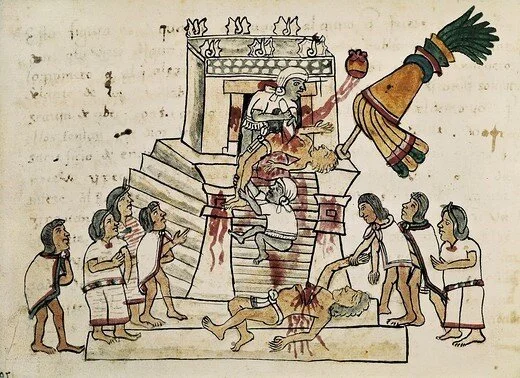
But the reason why I cannot conclude that the characters depicted on the texture are legitimate Aztecs is the insignia of Los Iluminados, as well as other remnants of ancient history based on the culture of Mesopotamia. So for me personally, it is more likely that the developers used different images of ancient civilizations as references to create a portrait of an ancient cult.
In other words, the game showed us Ganados sacrificing humans, so I can be positive that this practice has existed since ancient times, but I can't be sure and I'm not sure if the actual Aztec beliefs are relevant to a fictional context. That's why I expected the remake to offer a proper worldbuilding, and I can't say that I was disappointed, although it's quite subtle and not always intuitive.
First of all, and I'm confident in my research, the murals below represent the "Aztecs" from the original game:

What I love about them is that the images are drawn from scratch. They are completely fictional nonsense, and you can be sure that the developers didn't take someone's photos, but definitely made an effort, so you can safely think about the content.
Nevertheless, any artist has references, and you cannot do visual storytelling without universal motifs, because drawings are like a language, so they have their own kind of words. And this line of thought leads us to the question of who this mysterious figure is. Who is this weird monk-looking dude?
Well, it's rather apparent to me that his imagery is based on the motifs of South Asia and Hinduism in particular. You see, his position and the "sun" in place of his head have a common denominator: they're associated with the lotus. If the pose is known to many (especially for those who practice yoga) and needs no introduction, the head can be confusing. And here I will make a small digression: I can see how it reminds someone of René Magritte and Drew Struzan's masterpieces:
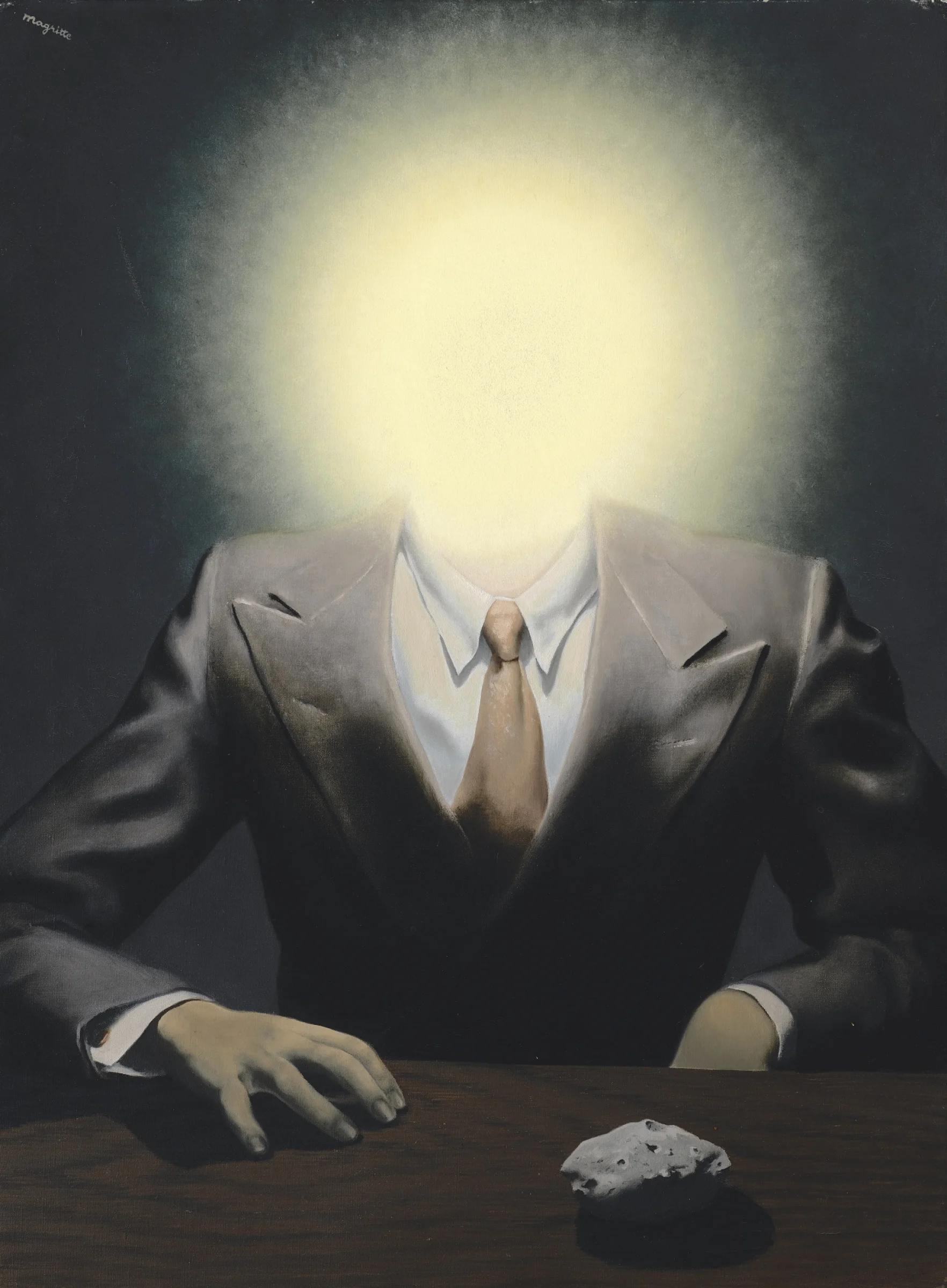

I don't think, however, that any of these arts have an actual connection with our monk. They do have a common trait, but it's very superficial and goes down to hiding identity with light. The authors' intentions are different, nevertheless: Magritte explored the paradox through how light, which helps us see in the dark, prevents us from seeing a face in a dark room, and Struzan presented an image of an alien, often associated with bright artificial light, which can have the shape of a human. In contrast, the monk from RE:4 has a Hindu motif, for his head is a version of the golden chakra ("wheel" or "circle"), the Sahasrara (the "thousand-petalled lotus"), which represents unity with the divine, where the body is a channel of godly energy. And symbolically, the golden hands resemble the manus dei motif from the early Middle Ages, which was designed by Christians to represent Yahweh's intervention without depicting his body, since it was unacceptable to depict god as a full human figure. However, it looks like the deity from the game has multiple hands, which again reminds us of Hinduism:

In other words, if we are trying to draw a conclusion, the monk is an avatar of the god worshipped by medieval monks. You may ask what all this has to do with Los Iluminados, except for the praying hands, which are also depicted on the statues of Osmund's predecessors, and human sacrifices, and I will answer that the lotus, pose and chakra have another universal denominator: they represent enlightenment, and this is exactly what the name "Los Iluminados" refers to.
This conclusion could have been the end of the story if Leon hadn't discovered this "exhibit" in the castle:

It looks familiar, doesn't it? The significant difference is that we have a parasite instead of a chakra, but the textures of this asset are still labeled as "god". And this bit leads us to the faith that Saddler preaches: he calls each Plaga a "holy body," which in any Christian denomination means the body of Jesus Christ, the incarnation of Yahweh, but in the context of the game, Los Iluminados believes that parasites are remnants of god that were discovered by Adam after the fall of Rome.
What might be interesting about this god is that Saddler tells Leon during the final battle that he has made the decision to sacrifice his body and consciousness to god so that he—this god—would be reborn, and the final form of the character is labeled as a "tree" in the game folders.
Do we have some kind of abnormal tree in the game in any shape or form? Yeah, we have, and we have it in BIO5 as well:
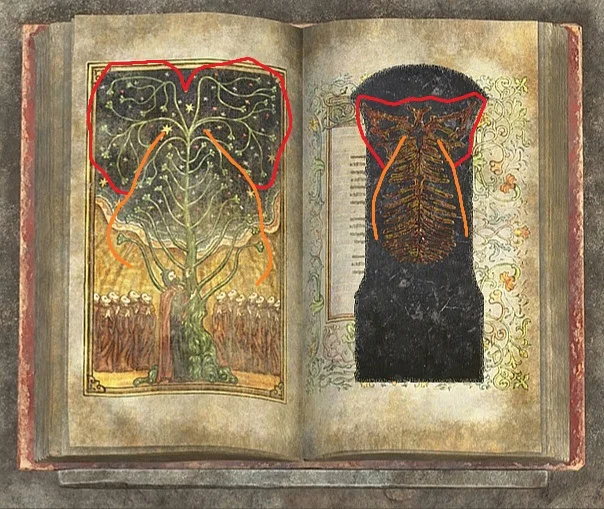

Note that the "tree" next to which Adam stands has the Plaga-like imagery, and the mural from Africa has fossils of parasites. Both images, of course, are an allusion to the tree of life, which is a universal archetype, but what also unites the plant and the Plaga? That's right, BIO4's Queen Plaga. The Queen Plaga doesn't just look like a plant, but has been likened to it in supplementary sources. And keeping this information in mind, we can assume that Saddler transcended into the Queen Plaga—into god. If this assumption is correct, we can also assume that at least one carrier has transcended into god before, since Adam saw the "tree". So who could it be?
Well, my guess is that the mysterious carrier was our monk, and his tissues can be found in an ancient chantry, a version of which was occupied by the Queen Plaga in the original game:

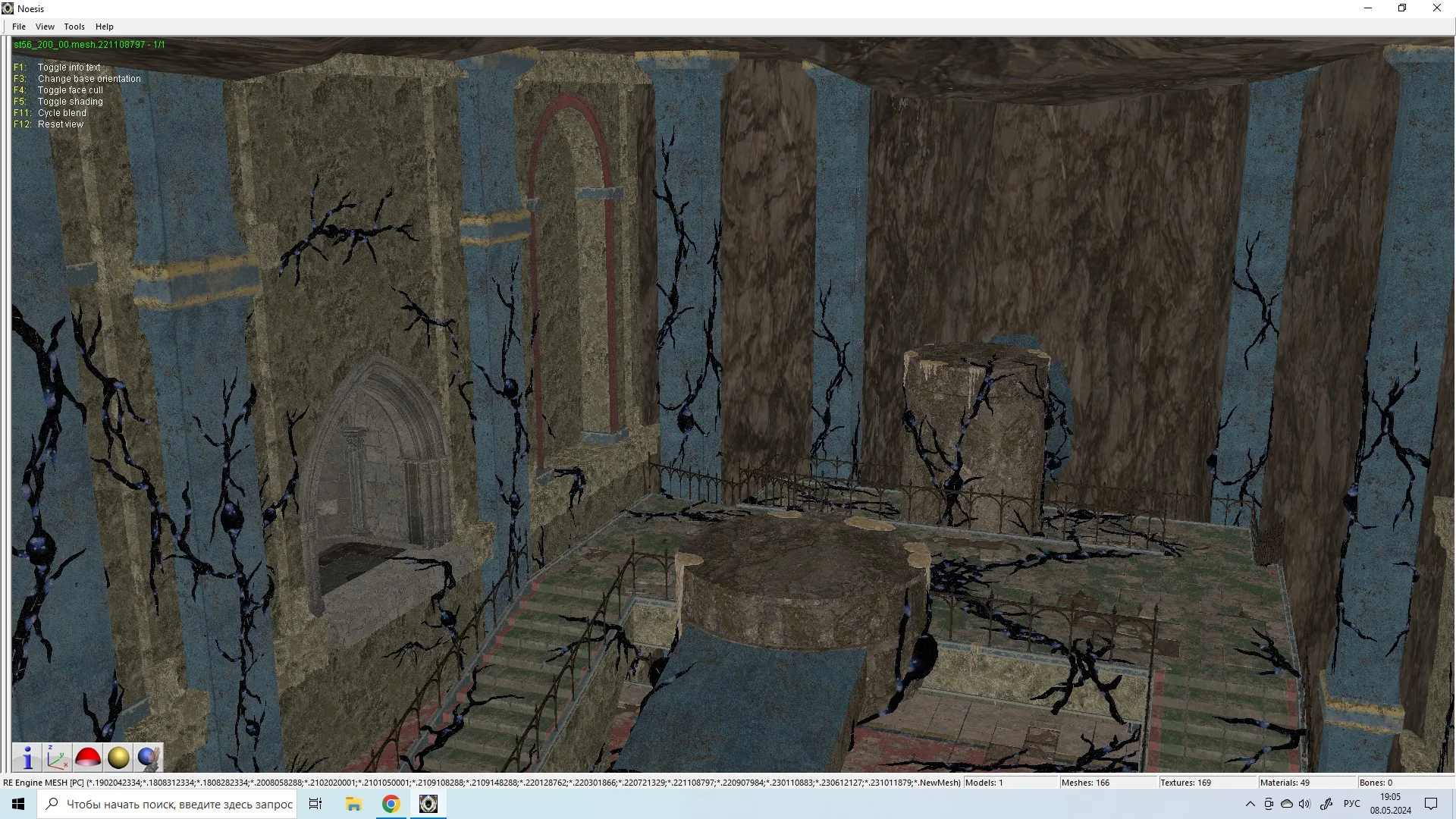


Adam discovered his faith after the Renaissance, but the style of that chantry looks like the legitimate Middle Ages, which is why I believe that it was built around the same period as the old castle, and these structures hardly existed before the 11th century, because they are based on the Gothic style. Some people recognize the Moroccan style in the ornament, but I did a little research and found out that one Russian group of enterprises produces ceramic tiles, the style of which is based on the old Italian majolica from Emilia-Romagna:

But more importantly, these tiles cover the ceiling of the monstrous building-like structure in the center, which turned out to be an altar, because that's how it's labeled in the game files.
Since ancient times, altars can be built in places where interaction with the deity took place for the first time or most vividly, so it makes sense that the giant Plaga at the bottom is the remnants of a god. The monstrous altar could be used for any kind of sacred rites, be it ritual sacrifices, baptism and so on, and this premise is actually very similar to the original game, if we think about it: Ashley was baptized at the place where the Queen Plaga was.
And this is the ancient history of RE:4's Los Iluminados in my interpretation…
Well, I think that's all I want to say so far, but most likely my post is only the first part, as there are still some aspects that I would like to touch on. Thanks for your time!
And now, without further ado, I would like to share the mentioned observations.
When RE:4 was announced, I wrote on this forum that I was excited about how Capcom could showcase the history of Los Iluminados, knowing that the original game offered only a few poorly edited textures, such as this one:
Of course, I can't say that even this mural is uninformative. If this is not a borrowed image, like many others in the game, the artist made an obvious allusion to the people of Mesoamerica and, most likely, specifically the Aztecs. This parallel is especially evident due to the flying heart with a bloody trail: the Aztecs believed that the human heart is a fragment of the sun's heat, so the sacrifice liberates this fragment, and it reunites with the sun.
But the reason why I cannot conclude that the characters depicted on the texture are legitimate Aztecs is the insignia of Los Iluminados, as well as other remnants of ancient history based on the culture of Mesopotamia. So for me personally, it is more likely that the developers used different images of ancient civilizations as references to create a portrait of an ancient cult.
In other words, the game showed us Ganados sacrificing humans, so I can be positive that this practice has existed since ancient times, but I can't be sure and I'm not sure if the actual Aztec beliefs are relevant to a fictional context. That's why I expected the remake to offer a proper worldbuilding, and I can't say that I was disappointed, although it's quite subtle and not always intuitive.
First of all, and I'm confident in my research, the murals below represent the "Aztecs" from the original game:
What I love about them is that the images are drawn from scratch. They are completely fictional nonsense, and you can be sure that the developers didn't take someone's photos, but definitely made an effort, so you can safely think about the content.
Nevertheless, any artist has references, and you cannot do visual storytelling without universal motifs, because drawings are like a language, so they have their own kind of words. And this line of thought leads us to the question of who this mysterious figure is. Who is this weird monk-looking dude?
Well, it's rather apparent to me that his imagery is based on the motifs of South Asia and Hinduism in particular. You see, his position and the "sun" in place of his head have a common denominator: they're associated with the lotus. If the pose is known to many (especially for those who practice yoga) and needs no introduction, the head can be confusing. And here I will make a small digression: I can see how it reminds someone of René Magritte and Drew Struzan's masterpieces:
I don't think, however, that any of these arts have an actual connection with our monk. They do have a common trait, but it's very superficial and goes down to hiding identity with light. The authors' intentions are different, nevertheless: Magritte explored the paradox through how light, which helps us see in the dark, prevents us from seeing a face in a dark room, and Struzan presented an image of an alien, often associated with bright artificial light, which can have the shape of a human. In contrast, the monk from RE:4 has a Hindu motif, for his head is a version of the golden chakra ("wheel" or "circle"), the Sahasrara (the "thousand-petalled lotus"), which represents unity with the divine, where the body is a channel of godly energy. And symbolically, the golden hands resemble the manus dei motif from the early Middle Ages, which was designed by Christians to represent Yahweh's intervention without depicting his body, since it was unacceptable to depict god as a full human figure. However, it looks like the deity from the game has multiple hands, which again reminds us of Hinduism:
In other words, if we are trying to draw a conclusion, the monk is an avatar of the god worshipped by medieval monks. You may ask what all this has to do with Los Iluminados, except for the praying hands, which are also depicted on the statues of Osmund's predecessors, and human sacrifices, and I will answer that the lotus, pose and chakra have another universal denominator: they represent enlightenment, and this is exactly what the name "Los Iluminados" refers to.
This conclusion could have been the end of the story if Leon hadn't discovered this "exhibit" in the castle:
It looks familiar, doesn't it? The significant difference is that we have a parasite instead of a chakra, but the textures of this asset are still labeled as "god". And this bit leads us to the faith that Saddler preaches: he calls each Plaga a "holy body," which in any Christian denomination means the body of Jesus Christ, the incarnation of Yahweh, but in the context of the game, Los Iluminados believes that parasites are remnants of god that were discovered by Adam after the fall of Rome.
What might be interesting about this god is that Saddler tells Leon during the final battle that he has made the decision to sacrifice his body and consciousness to god so that he—this god—would be reborn, and the final form of the character is labeled as a "tree" in the game folders.
Do we have some kind of abnormal tree in the game in any shape or form? Yeah, we have, and we have it in BIO5 as well:
Note that the "tree" next to which Adam stands has the Plaga-like imagery, and the mural from Africa has fossils of parasites. Both images, of course, are an allusion to the tree of life, which is a universal archetype, but what also unites the plant and the Plaga? That's right, BIO4's Queen Plaga. The Queen Plaga doesn't just look like a plant, but has been likened to it in supplementary sources. And keeping this information in mind, we can assume that Saddler transcended into the Queen Plaga—into god. If this assumption is correct, we can also assume that at least one carrier has transcended into god before, since Adam saw the "tree". So who could it be?
Well, my guess is that the mysterious carrier was our monk, and his tissues can be found in an ancient chantry, a version of which was occupied by the Queen Plaga in the original game:
Adam discovered his faith after the Renaissance, but the style of that chantry looks like the legitimate Middle Ages, which is why I believe that it was built around the same period as the old castle, and these structures hardly existed before the 11th century, because they are based on the Gothic style. Some people recognize the Moroccan style in the ornament, but I did a little research and found out that one Russian group of enterprises produces ceramic tiles, the style of which is based on the old Italian majolica from Emilia-Romagna:
But more importantly, these tiles cover the ceiling of the monstrous building-like structure in the center, which turned out to be an altar, because that's how it's labeled in the game files.
Since ancient times, altars can be built in places where interaction with the deity took place for the first time or most vividly, so it makes sense that the giant Plaga at the bottom is the remnants of a god. The monstrous altar could be used for any kind of sacred rites, be it ritual sacrifices, baptism and so on, and this premise is actually very similar to the original game, if we think about it: Ashley was baptized at the place where the Queen Plaga was.
And this is the ancient history of RE:4's Los Iluminados in my interpretation…
Well, I think that's all I want to say so far, but most likely my post is only the first part, as there are still some aspects that I would like to touch on. Thanks for your time!
Last edited:
